Tennis or golfer’s elbow that will not quit? Here is how to actually fix it
Nagging elbow pain that flares every time you grip, lift, or type is frustrating, and it rarely settles on its own. The good news: the large majority of tennis and golfer’s elbow cases get better with the right conservative care, without surgery or a cortisone shot. The catch is that these are slow-healing tendons, so the fix is not rest and painkillers, it is a proper plan that reloads and rebuilds the tendon. At Atlas Spine Clinic in Scarborough, that is exactly what we do, with the option to escalate stubborn cases to shockwave therapy under the same roof.
Here is what is actually going on with tennis elbow and golfer’s elbow, and how to get lasting relief.
Tennis elbow vs golfer’s elbow: same problem, opposite sides
The two are mirror images of each other:
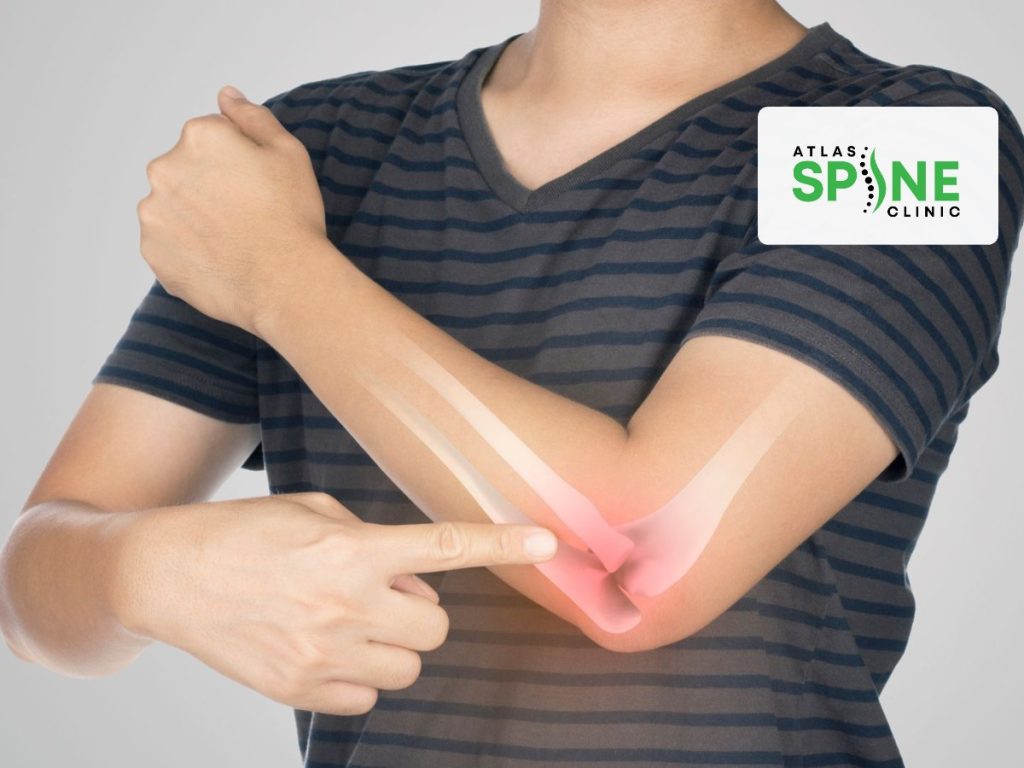
- Tennis elbow is pain on the outer side of the elbow, where the extensor tendons that lift and straighten your wrist and fingers attach.
- Golfer’s elbow is pain on the inner side, where the flexor tendons that curl your wrist and grip attach.
Same underlying problem, opposite side of the elbow. Both are aggravated by gripping, and both tend to build gradually rather than from one sudden injury.
It is not really “inflammation” (why the name is misleading)
Despite the “itis” in epicondylitis, this is not simple inflammation. It is a tendinopathy, a wear-and-overload problem where the tendon has been stressed faster than it can repair itself. That distinction matters, because it changes the whole treatment. You cannot just calm inflammation and wait. The tendon needs to be gradually reloaded so it can remodel and rebuild its capacity. That is why passive rest alone tends to fail, and why a structured strengthening plan is the thing that actually works.
How we diagnose it, and rule out the mimics
Getting the diagnosis right is half the battle. At Atlas, assessment starts with a detailed history and a physical exam of your movement, strength, and flexibility to identify the specific structures involved. For the elbow, that usually means pinpointing the exact tender spot, testing whether pain reproduces with resisted wrist movement and gripping, and checking your range.
Just as important, we screen for the conditions that mimic elbow tendinopathy, because arm pain is not always coming from the tendon. It can be a pinched nerve, pain referred from the neck, or joint arthritis. So we check the neck and nerve pathways and look for numbness, tingling, or weakness that would point away from a simple tendon problem. If the picture is unclear or suggests something structural, we coordinate with your doctor or refer you out for imaging.
How we treat tennis and golfer’s elbow at Atlas
The backbone of tendinopathy care is load management plus progressive strengthening, and our physiotherapy toolkit is built around that:
- Progressive strengthening is the core. For a tendon, that centres on controlled loading, classically eccentric work where the muscle lengthens under load, which is what stimulates the tendon to remodel and rebuild.
- Manual therapy and soft tissue therapy, including joint mobilization, myofascial release, and trigger point work, to ease muscle tension and improve mobility.
- Electrotherapy such as IFC, TENS, and ultrasound to help with pain and circulation, especially early on.
- Shockwave therapy for stubborn cases. We use shockwave specifically for chronic tendon and soft tissue issues that have not responded to conventional care, which is textbook for a lingering tennis or golfer’s elbow.
- Laser therapy and acupuncture to support pain relief alongside the loading program.
A counterforce brace and some workstation or activity changes are usually a sensible part of managing the load, too, and we will talk through what fits your situation. On timeline, let us be honest: this is a slow-healing tendon measured in weeks to months, not days. The reassuring part is that the large majority of cases resolve with conservative care, without surgery or cortisone. Patience and consistency with the loading program are what get you there. We will not promise an exact recovery time, because it depends on how severe it is and how long you have had it.
Who actually gets it (hint: it is not just tennis players)
The name is misleading, and this is worth knowing. While racquet-sports players and golfers certainly get it, in a Scarborough clinic the bigger share comes from repetitive work and daily overload, not sport:
- Desk and mouse users with repetitive wrist and grip strain.
- Trades and manual workers doing gripping, twisting, lifting, and tool use.
- New parents, from the constant gripping and lifting of a baby.
- Anyone whose job or hobby involves sustained, repetitive hand tasks.
It usually shows up in your dominant arm, or whichever arm is doing the repetitive task, and it tends to build gradually. So the typical patient is less the weekend tennis player and more the person whose work or daily demands have quietly overloaded the tendon over time. If your pain is more work-related, our note on shoulder, elbow, and wrist pain is a useful companion read, and our hand and wrist exercises can help too.
The mistakes that keep elbow pain going
Most people fall into one of two opposite traps:
- Pushing through the pain, continuing the aggravating activity and reinjuring the tendon before it can recover.
- Resting it completely, doing nothing and hoping it settles. For a tendinopathy this backfires, because the tendon never rebuilds its capacity and stays weak and prone to flaring.
The right path is managed loading, not either extreme. A few more common mistakes:
- Relying only on a brace or painkillers, which can mask symptoms without fixing the underlying tendon.
- Chasing a cortisone shot as a first resort. It may give short-term relief, but it does not rebuild the tendon and is not the conservative first line.
- Stopping too soon, quitting the strengthening program the moment the pain eases but before the tendon has actually recovered. That is how people end up in a repeat cycle.
The through line: this needs consistent, progressive loading over time, not a quick fix.
When to get it checked, and not just wait it out
Some situations should not be left to sort themselves out. See a professional, and let us coordinate with your doctor, if you have:
- Numbness, tingling, or weakness in the hand or fingers, which suggests nerve involvement rather than a simple tendon problem.
- A suspected tendon tear or a sudden, significant injury, which needs medical evaluation and possibly imaging.
- Pain that fails to improve at all despite appropriate conservative care, which should be re-examined.
Why Scarborough patients choose Atlas Spine Clinic
What makes us a strong fit for stubborn elbow pain is the genuinely multidisciplinary team under one roof: physiotherapy, chiropractic, massage, acupuncture, and modalities including shockwave and laser. That means a difficult tendon case can escalate from loading and manual therapy to shockwave without you having to go elsewhere. Add a free 15-minute consultation as a low-pressure starting point, same-week availability, and coverage through most extended health plans as well as WSIB and MVA where the injury qualifies.
A few honest caveats worth keeping in mind: we cannot promise a fixed recovery time or guaranteed results, since tendons heal slowly and variably. Shockwave is an option for chronic cases, not a guaranteed cure. And coverage depends on your own plan. Standard physiotherapy is not covered by OHIP for most adults, so it is worth confirming your benefits when you call.
Frequently asked questions
Do you only get tennis elbow from tennis?
No. That is the biggest myth. Most cases come from everyday repetitive gripping and lifting, at work, at a desk, in the trades, or from caring for a baby, not from sport.
Do I need a cortisone shot or surgery?
Usually not. The large majority of tennis and golfer’s elbow cases resolve with conservative care. Cortisone can give short-term relief but does not rebuild the tendon, and surgery is a last resort for the small number of cases that do not respond.
How long does it take to heal?
Tendons heal slowly, so think weeks to months rather than days. The exact timeline depends on severity and how long you have had it, and consistency with the strengthening program is what makes the difference.
Does shockwave therapy work for elbow pain?
It can be a helpful option for chronic, stubborn cases that have not responded to conventional treatment. We offer it in-clinic and use it as part of a broader plan, not as a standalone guaranteed cure.
Should I just rest my elbow until it feels better?
Complete rest usually backfires for a tendinopathy, because the tendon stays weak. The better approach is managed loading, easing off what aggravates it while gradually strengthening the tendon.
Book a free consultation in Scarborough
If your elbow pain has been dragging on, the sooner you start the right loading program, the sooner you break the cycle. Call (647) 794-6868 to book a free 15-minute consultation at Atlas Spine Clinic in Scarborough. We will assess your elbow, rule out the mimics, and build you a plan, from progressive strengthening to physiotherapy and shockwave if needed, to get you back to gripping, lifting, and playing without pain. See our price list for details.
