
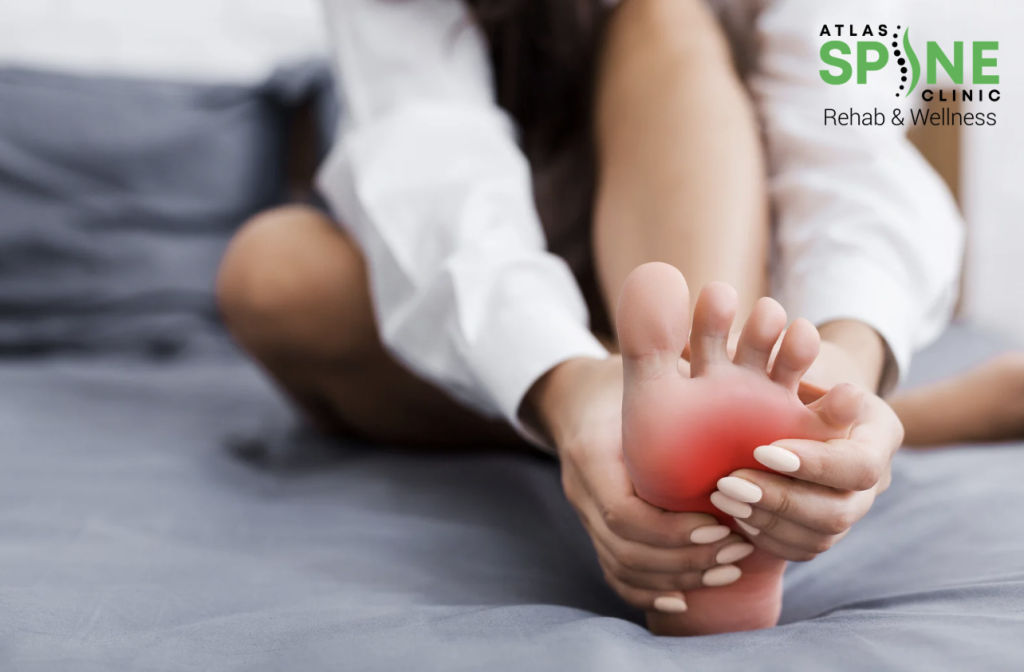
The Kinetic Chain Connection: How Your Feet Can Cause Knee, Hip, and Back Pain
You’ve stretched. You’ve strengthened. You may have even treated the painful area directly — yet your knee, hip, or back pain keeps coming back.
That’s often the clue most people miss.
Pain doesn’t always start where you feel it. Very often, it begins at your foundation — your feet.
At Atlas Spine Clinic, we regularly see patients whose pain persists because the true cause lies upstream or downstream from the painful area. This guide explains the kinetic chain clearly, without hype, so you can finally understand what your body has been trying to tell you.
What Is the Kinetic Chain?
The kinetic chain describes how your body moves as one connected system.


Your feet, ankles, knees, hips, pelvis, and spine don’t work independently. Each step sends force upward through the chain. If one link is misaligned, the rest must compensate.
Your feet matter most because they are:
- Your point of contact with the ground
- Your shock absorbers
- Your alignment guides
When the foundation is unstable, everything above it adapts — often painfully.
The Foundation Problem: Overpronation & Supination
Most kinetic chain dysfunction starts with how your foot interacts with the ground.
Overpronation
- Foot rolls too far inward
- Arch collapses
- Knee rotates inward
- Hip and pelvis lose stability
Supination (Underpronation)
- Foot rolls outward
- Poor shock absorption
- Excess stress on outer knee, hip, and spine
These are not “foot problems.”
They are whole-body alignment problems.
Simple Self-Checks You Can Do Today
Wet Foot Test
- Full footprint → likely overpronation
- Thin outer edge only → likely supination
- Clear arch curve → neutral
Shoe Wear Pattern
- Inside edge worn → overpronation
- Outside edge worn → supination
These don’t replace an assessment — but they often confirm suspicions.
The Domino Effect: How Foot Issues Cause Pain Above
Knee Pain
Poor foot alignment twists the knee joint thousands of times per day, contributing to:
- Runner’s knee
- IT band syndrome
- Early joint wear
Hip & Pelvis Pain
Lower-leg rotation alters hip mechanics, leading to:
- Gluteal weakness
- Hip bursitis
- Pelvic tilt
Lower Back Pain
Pelvic imbalance increases spinal stress, often resulting in:
- Chronic low back pain
- Muscle spasms
- Sciatica-like symptoms
Stretching alone rarely fixes this — because the cause remains under load all day.
The Full Spectrum of Solutions (No One-Size-Fits-All)
At-Home Support
- Calf, hamstring, hip mobility
- Glute and core strengthening
- Balance training
Helpful — but often incomplete.
Footwear & Over-the-Counter Insoles
- Supportive shoes are essential
- OTC insoles can help mild issues
They provide cushioning, not correction.
Professional, Non-Surgical Care
Custom Orthotics
- Built from a 3D foot assessment
- Correct your specific mechanics
- Realign the entire kinetic chain
Often the missing link for persistent knee, hip, or back pain.
Physiotherapy
- Corrects muscle imbalances
- Improves joint control and stability
Chiropractic Care
- Restores alignment and joint motion
- Addresses compensations in spine and pelvis
Advanced Therapies
- Shockwave therapy
- Laser pain relief
Used when secondary tissue damage exists.
Choosing the Right Starting Point
| Your Situation | Best First Step |
|---|---|
| Mild or early pain | Footwear + targeted exercises |
| Persistent pain | Professional biomechanical assessment |
| Failed prior treatment | Integrated kinetic chain reassessment |
Frequently Asked Questions
Are custom orthotics really worth it?
For structural misalignment, yes. They correct — not just cushion.
How long until I notice improvement?
Most people feel changes within 2–4 weeks as alignment normalizes.
Can exercises replace orthotics?
Exercises help muscles adapt — but they can’t correct faulty foot mechanics alone.
Can feet affect neck and shoulders?
Yes. Compensation travels upward to keep your eyes level.
Take the Guesswork Out of Your Pain
If pain keeps returning despite treatment, your body may be compensating from the ground up.
At Atlas Spine Clinic, we assess your entire kinetic chain, not just the painful spot. That’s how lasting relief happens.
Book a complimentary consultation and find out whether your feet are the missing piece.
